No products in the basket.
100% Pet-Friendly & 15-year UV Warranty
100% Pet-Friendly & 15-year UV Warranty
Bankhouse Farm, Pincheon, Green Lane, Sykehouse, DN14 9AD
Mon-Fri: 9 am to 5 pm
Bankhouse Farm, Pincheon, Green Lane, Sykehouse, DN14 9AD
Mon - Fri: 9:00 AM - 5:00 PM
Sat - Sun: Closed

Pet Turf specialises in artificial grass for dogs and fake grass for dogs built for real UK homes and commercial sites. Our 3 Phase K9 System combines a free-draining limestone base, specialist turf with knitted RapidFlow or ProFlow backing, and a proven enzyme cleaner. The result is a clean, low-odour lawn that drains fast, resists digging, and lasts up to 15 years. No mud, no urine damage, and minimal maintenance. Just a practical, pet-safe surface your dogs will actually use.
No projects found.
Copyright © Pet Turf Ltd, All Rights Reserved. (Company No: 11890447)
Bankhouse Farm, Pincheon Green Lane, Sykehouse, DN14 9AD
Mon - Fri: 9:00 AM - 5:00 PM
Sat: 10:00 AM - 3:00 PM
Sun: Closed
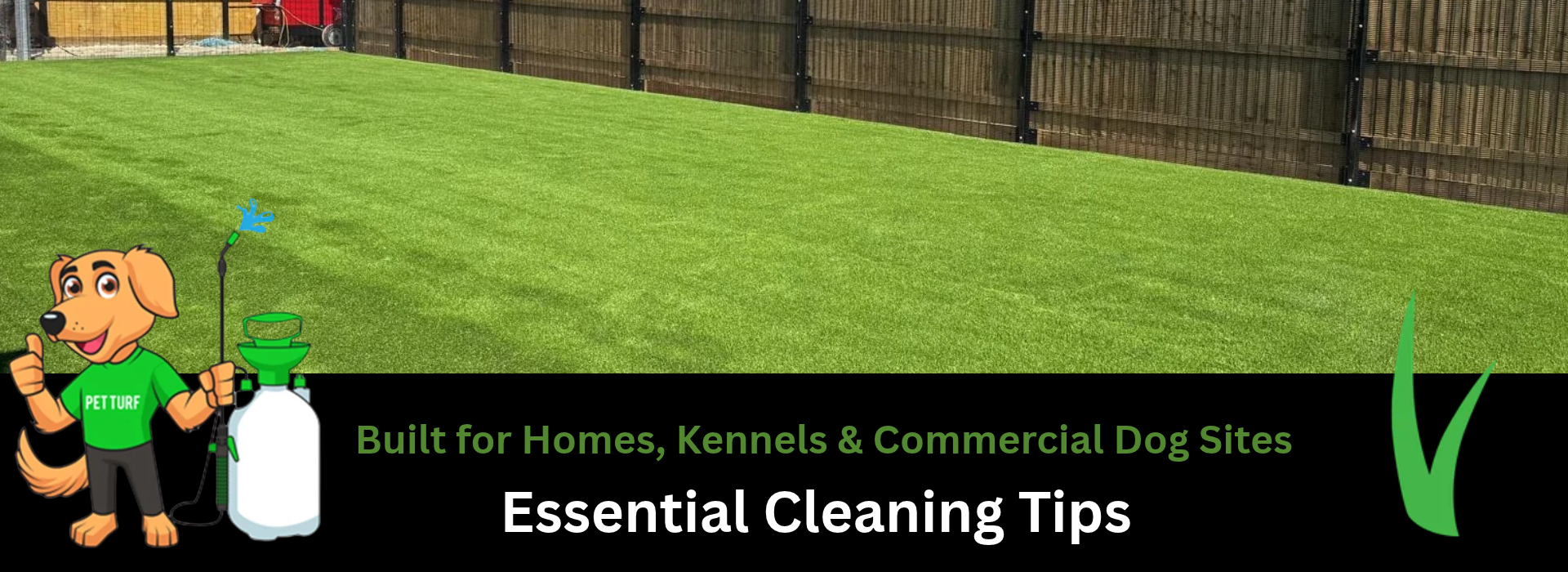
Knowing how to clean artificial grass properly takes about ten minutes a week once you have a routine. Most of it is just water and a stiff brush. The rest is picking the right product for dog urine, which is where people usually go wrong. Here’s the routine we give every Pet Turf customer, plus fixes for the messier jobs.
You don’t need much, and most of it you’ll already own.
Pick up poo and rinse any wee spots in busy corners.
Clear leaves, brush high-traffic areas and give the lawn a hose-down.
Apply enzyme cleaner. With several dogs, do it every one to two weeks.
This is the deeper way to clean artificial grass. We suggest it once a month, or more often with several dogs.
On a big lawn, try applying the cleaner when light rain is forecast. Then the rain spreads and rinses it for you.
| Turf backing | Cleaner per litre of water |
|---|---|
| Pet Turf Premier Knitted | 50 ml |
| K9 Grass Classic Eco ProFlow | 100 ml |
| PU backing with holes | 150 ml |
| Latex backing with holes | 200 ml |
One full sprayer tank covers about 30–40 m².
Let fresh poo firm up for a few minutes if it’s soft, then lift it with a bag or scoop. After that, rinse the spot and spray a little enzyme cleaner over it.
If it has dried into the fibres, soak the area first. Then work it loose with a brush and rinse again. Avoid scraping with a spade, because the edge can cut the pile.
Water alone moves most urine through a good lawn. However, the smell comes from what stays behind: urea, proteins and bacteria clinging to the fibres or sitting in the base.
An enzymatic cleaner digests those compounds rather than covering them. So rinse the hot spots every few days and treat them with the K9 Turf Bio-Enymatic Artificial Grass Cleaner about once a month. With several dogs, treat every week or two.
If a lawn still smells after that, the problem is usually below the turf. A sandy base or a latex backing traps urine that cleaning can’t reach. We explain why in our guide to the best cleaner for artificial grass.
Jet washing: We’d avoid it at close range. High pressure can stress the backing, open joins and blast out infill. If you must, use a wide fan nozzle and keep it well back.
Hoovering: A normal vacuum isn’t needed outdoors. Instead, a leaf blower on low clears dust and leaves faster. Some people use a wet-and-dry vac on small balconies, which is fine.
Washing-up liquid: A few drops in warm water are fine for a spilled drink or a sticky patch. Rinse it well afterwards. However, it won’t break down urine, so it’s no substitute for an enzyme cleaner.
Bleach, vinegar and disinfectant: Skip them. Bleach can discolour the fibres, while strong disinfectants can irritate paws. Vinegar only swaps one smell for another.
Spring: Brush the whole lawn to lift the pile after winter. Then pull any weeds growing at the edges and do a full enzyme clean.
Summer: Warm weather makes smells more noticeable, so rinse more often. Turf also heats up in strong sun. Hose it down before your dog goes out, and learn the signs of heatstroke in dogs from the RSPCA.
Autumn: Leaves are the main job. Clear them weekly before they rot and stain.
Winter: Leave frost and snow to melt rather than shovelling, as a spade can damage the fibres. Avoid rock salt too.
Not every lawn was fitted with dogs in mind, and some are harder to clean. Artificial grass with a latex backing is the usual culprit. If you’ve inherited turf like that, or one with a PU backing, cleaning takes more effort. Still, it can be improved, and our astro turf cleaner guide shows the rate and routine for each backing.
Pick a wet day. Apply the enzyme cleaner at the stronger dilution for your backing, leave it, then let the rain soak it into the base. Repeat this every week for a month. Many lawns get noticeably fresher, although they still need weekly attention afterwards. For very stubborn smells, our heavy-duty K9 Turf Last Resort is applied the same way. If the smell keeps coming back, it’s usually cheaper in the long run to replace the base and turf than to keep fighting it.
Most spills come out with warm water, a drop of washing-up liquid and a brush. For chewing gum, harden it with an ice cube first, then pick it off. Keep barbecues, fire pits and glass ornaments off the lawn, since heat and reflected sunlight can melt fibres.
The right turf and base make cleaning much easier. A knitted backing drains across its whole surface, so less residue is left behind. Meanwhile, a clean limestone base won’t hold urine underneath. That’s why we fit every lawn as part of our 3 Phase System for dogs.
For brushing, edge checks and our maintenance visits, see our artificial grass maintenance page.
Clear debris, rinse the surface, apply a suitable cleaner (ideally a bio-enzymatic one for pets), allow it to dwell, rinse thoroughly, then brush the fibres upright. This is the method we recommend at PetTurf for both everyday and deeper cleans.
Weekly light cleaning (debris removal + rinse) plus monthly enzyme treatment works well for most homes. Homes with several dogs or high-use areas benefit from more frequent enzyme treatment.
Yes. The K9 Enzyme Cleaner recommended by PetTurf is non-toxic and formulated to be safe for dogs, cats and children when used as directed.
We advise against it. Many household products leave residue or only mask odours. A dedicated artificial grass cleaner, especially a bio-enzymatic one, breaks down urine at the source and is better for the turf.
Choose fast-draining pet-specific turf (such as the knitted or ProFlow ranges available from PetTurf) and use a bio-enzymatic cleaner regularly. This combination gives the most reliable long-term odour control.
Scoop solid waste straight away, rinse the area with water, then treat with a bio-enzymatic cleaner. PetTurf recommends the K9 Enzyme Cleaner for this step because it digests the organic matter rather than just covering the smell.
Daily waste removal, regular rinsing, and scheduled enzyme cleaner applications. Pairing this routine with PetTurf’s fast-draining dog-specific turf keeps maintenance simple and the surface hygienic.
Use a pet-safe bio-enzymatic cleaner rather than bleach or strong household disinfectants. The K9 Enzyme Cleaner we recommend breaks down bacteria and organic waste at source while remaining safe around dogs and children.
Most households do well with treatment every 2–4 weeks. Multi-dog homes, kennels or high-traffic areas usually benefit from use every 1–2 weeks.
It needs less overall work (no mowing, feeding or watering), but it still needs regular debris removal, rinsing and occasional enzyme cleaning — especially when dogs use it. With the right routine and products from PetTurf, upkeep stays quick and straightforward.
Pet Turf specialises in artificial grass for dogs and fake grass for dogs built for real UK homes and commercial sites. Our 3 Phase K9 System combines a free-draining limestone base, specialist turf with knitted RapidFlow or ProFlow backing, and a proven enzyme cleaner. The result is a clean, low-odour lawn that drains fast, resists digging, and lasts up to 15 years. No mud, no urine damage, and minimal maintenance. Just a practical, pet-safe surface your dogs will actually use.
Head Office: Bankhouse Farm, Pincheon, Green Lane, Sykehouse, DN14 9AD

K9 Turf logo are registered trademarks UK00003273823
Copyright © Pet Turf Ltd, All Rights Reserved. (Company No: 11890447)