No products in the basket.
100% Pet-Friendly & 15-year UV Warranty
100% Pet-Friendly & 15-year UV Warranty
Bankhouse Farm, Pincheon, Green Lane, Sykehouse, DN14 9AD
Mon-Fri: 9 am to 5 pm
Bankhouse Farm, Pincheon, Green Lane, Sykehouse, DN14 9AD
Mon - Fri: 9:00 AM - 5:00 PM
Sat - Sun: Closed

Pet Turf specialises in artificial grass for dogs and fake grass for dogs built for real UK homes and commercial sites. Our 3 Phase K9 System combines a free-draining limestone base, specialist turf with knitted RapidFlow or ProFlow backing, and a proven enzyme cleaner. The result is a clean, low-odour lawn that drains fast, resists digging, and lasts up to 15 years. No mud, no urine damage, and minimal maintenance. Just a practical, pet-safe surface your dogs will actually use.
No projects found.
Copyright © Pet Turf Ltd, All Rights Reserved. (Company No: 11890447)
Bankhouse Farm, Pincheon Green Lane, Sykehouse, DN14 9AD
Mon - Fri: 9:00 AM - 5:00 PM
Sat: 10:00 AM - 3:00 PM
Sun: Closed
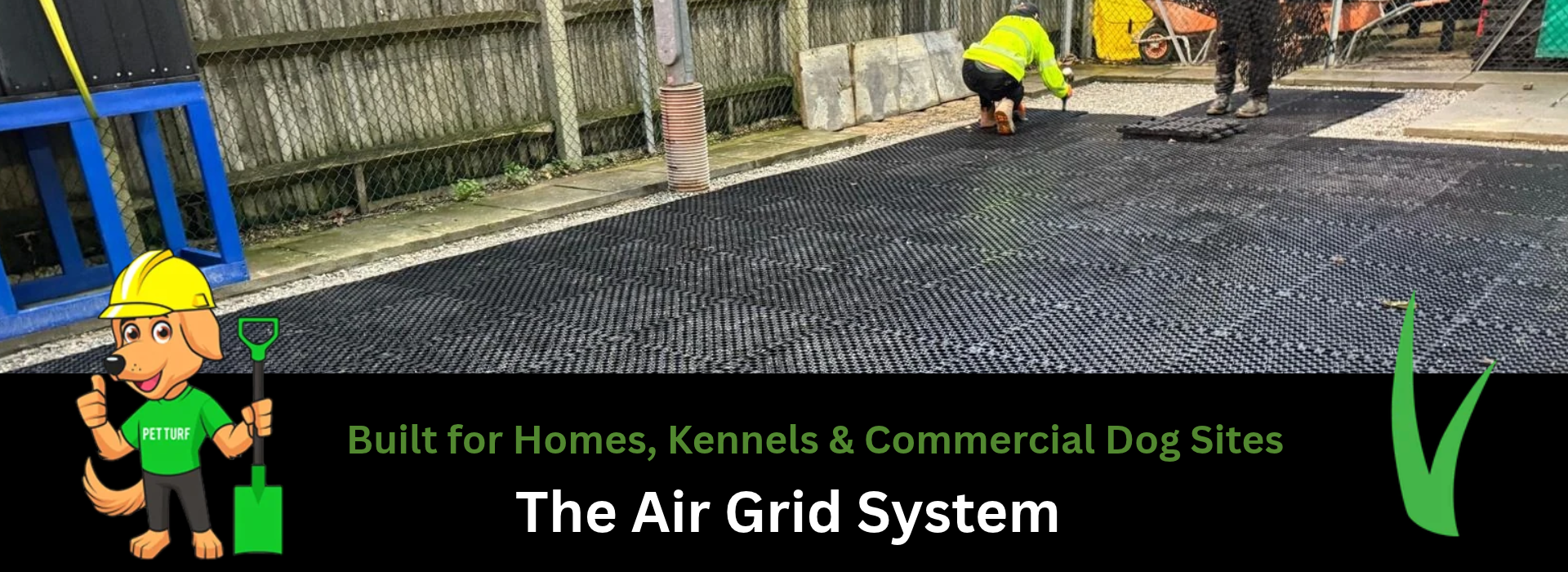
A standard lawn often fails when dogs use it all day. Mud, puddles and lingering smells soon appear. A proper fake grass installation can fix that, but only if the layers under the turf actually drain. That’s why we don’t just roll grass onto soil. Instead, we dig out 75–125 mm (3–5 inches), lay a clean limestone base, then lock Air Grid panels together and lay Premier Knitted on top. As a result, urine and wash-down water drop through the turf and keep moving, rather than sitting in the base.
Clean stone lets liquid pass through, instead of holding it like sand or MOT.
The Air Grid lifts the turf so urine can drop into a ventilated gap.
Premier Knitted drains up to 800% faster than a standard punched-hole backing.
Suits kennels, daycare, working-dog compounds and multi-dog homes.
Many installers still lay turf on MOT type 1 or sharp sand. For a show lawn that only sees rain, that can look fine at first. However, dog urine behaves differently. It soaks into fine material, dries out, and leaves crystals behind. Then the smell comes back every time the sun warms the lawn.
So we use clean limestone instead. It drains freely and doesn’t hold liquid in the same way. We also skip a weed membrane. The stone goes straight onto the dug-out ground, so nothing sits between the soil and the base to trap moisture.
This matters even more in a kennel or a run you hose down daily. Water has to leave the surface quickly. Otherwise the lawn stays wet, and cleaning becomes a chore. For those sites, the limestone is only the first layer. We then add the Air Grid on top.
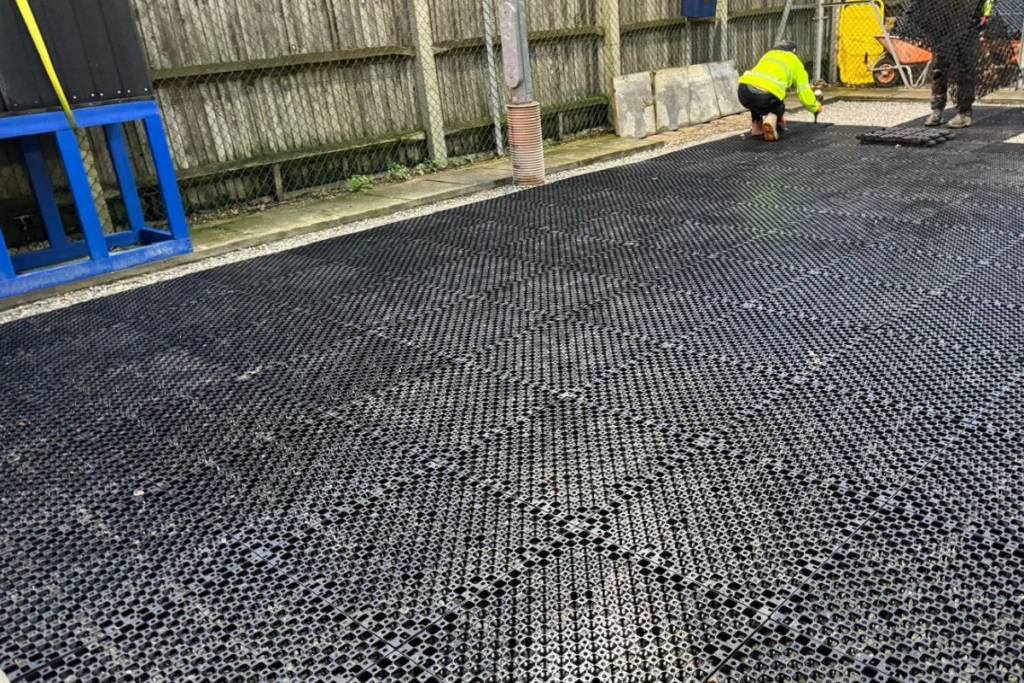
Basically, the Air Grid is a set of interlocking 1 m × 1 m panels. We click them together in a jigsaw pattern across the whole area. Then we lay Premier Knitted on top. The panels hold the turf slightly above the stone, leaving a ventilated gap underneath.
When a dog wees, the liquid passes through the knitted backing and drops into that gap. From there it follows the fall of the base and keeps moving down through the limestone. Meanwhile, air flowing through the void helps the lawn dry after rain or a rinse.
We only fit Premier Knitted on the Air Grid, because its knitted backing drains across the whole surface. The pile height is 28 mm. Also, the knit locks the yarn in place, so it’s harder for a dog to tear. Compare our ranges on the best dog turf page.

On a typical job our team covers around 30–40 m² a day once materials are on site. So a typical run takes a day or two. Larger commercial compounds take longer, and we’ll confirm the timescale with your quote.
Commercial dog areas take far more wear than a garden. Dogs use the runs all day, and staff hose them down often. As a result, any weakness in drainage or hygiene shows up fast.
The Border Force dog compounds at Felixstowe and Dover are a good example. Those jobs were on soil, not concrete. First we dug out the old surface. Then we laid a limestone base, fitted the Air Grid and laid the pet turf on top as one system. At Dover we completed three compounds in this way.
The open void under the turf gives wash-down water a clear path through the surface. So staff spend less time hosing, and the run dries faster between groups. After rain, the outdoor area stays usable. It doesn’t hold puddles or odour in the old ground the way the previous surface did.
If you run boarding kennels or daycare, it’s worth reading the government’s animal activities licensing guidance for your setting. Then talk to us about a surface that’s quick to clean.
You don’t need a Border Force site to need this system. Boarding kennels, daycare yards and multi-dog homes put the same kind of pressure on a lawn. Frequent wees, claws and hose-downs soon find a weak base.
That’s where the Air Grid earns its keep on soil. Clean limestone carries the load and drains freely. Above it, the grid lifts the turf and keeps air moving underneath. Premier Knitted takes the wear and lets liquid through quickly. Together they give you an outdoor surface you can wash and use again the same day.
We only use the Air Grid on installs carried out by our own team. We don’t sell the panels in the shop. Instead, we price them as part of each job. Our team covers the whole UK.
You don’t always start from soil, though. If you already have a sound patio, slab, deck or suitable roof, we can often fit the Air Grid straight onto that surface, with no dig-out. The idea is the same. Those panels lift the turf so urine can run off the hard surface, instead of pooling under the backing.
One warning is worth repeating here. Please don’t glue PU-backed or latex-backed turf straight onto a slab if a dog will use it. Urine can’t drain away, so it pools under the backing, smells, and bacteria can build up. People who try it often take the lawn up within months. Our safe method is Premier Knitted on the Air Grid, which we set out fully in our guide to laying turf on a patio or slab. For a standard garden install without the Air Grid, see our artificial grass installation guide.
We price each job individually, because no two sites are the same. The main factors are:
To give you an idea, turf alone for a 30 m² run would be £1,348.50 in Premier Knitted. Groundwork, the Air Grid, labour and delivery come on top. For an installed price, ask us for a quote. We don’t publish a fitted price per m², because access and groundwork change the figure too much.
Premier Knitted also carries a 15-year UV warranty. That warranty covers supply-only orders too.
Once materials are on site, our team usually fits around 30–40 m² a day. So a typical back garden or small run takes a day or two. Awkward access, a deep dig-out or a large commercial compound will add time. We’ll set that out in your quote before we start.
If you’d rather handle the turf yourself, you can still buy Premier Knitted from us as a supply-only order. However, we don’t supply the Air Grid for DIY fitting. For this system, our team does the groundwork and the grid as well as the turf.
A good base does most of the work. Even so, the lawn still needs a simple routine. Rinse it regularly, especially in busy runs, and brush the pile when it looks flat. For a full routine, see our cleaning guide and our artificial grass maintenance page.
In kennels and daycare, a weekly or fortnightly clean with K9 Turf Bio-Enymatic Artificial Grass Cleaner helps break down residue that water alone can leave behind. Because of the open void, the rinse water can carry that residue down through the grid, instead of pushing it around the surface.
A proper Pet Turf fake grass installation starts with a free-draining limestone base. Interlocking elevated air grid panels are then locked together across the area, and the pet-specific turf is laid on top. The turf is secured with galvanised nails, joins are fixed with specialist tape and adhesive, and edges are finished cleanly against surrounding surfaces.
Cost depends on site size, ground conditions, and whether an elevated air grid is required. Pet Turf provides tailored quotes after assessing the area, as high-use dog compounds need a stronger specification than a standard garden.
Pet Turf uses a free-draining limestone base: a 20 mm clean limestone layer topped with a compacted 6 mm clean limestone layer. This creates a stable, level surface that supports the elevated air grid and keeps water moving.
Yes. Soft ground is excavated and replaced with the limestone base system. On concrete or existing hard surfaces the elevated air grid can often be fitted directly, provided the surface is clean, stable and allows drainage.
Most residential areas are completed in one to two days. Larger commercial kennels or compounds with full base preparation and elevated air grid may take longer, depending on access and groundworks required.
For lasting results, especially in dog areas, professional installation is recommended. Pet Turf handles the full process—base preparation, elevated air grid, turf fitting and finishing—so the surface performs under daily use.
Existing turf or topsoil is removed, the area is levelled, and the free-draining limestone base is installed and compacted. Edges are prepared so the elevated air grid and turf can be fitted tightly against fences, concrete or slabs.
Pet Turf secures the turf with galvanised nails for durability. All joins are fixed with specialist tape and adhesive, and edges are carefully finished to prevent lifting and create a clean transition.
For dogs, Pet Turf specifies the elevated air grid system as part of the fake grass installation. The grid lifts the turf off the base, improves drainage and cleaning, and is combined with a pet-specific turf designed for hygiene and heavy use.
Regular hose-downs keep the surface clean. The elevated air grid helps water and liquid pass through quickly so the area dries faster. Occasional brushing keeps the pile upright; no mowing or chemical treatments are required.
Pet Turf specialises in artificial grass for dogs and fake grass for dogs built for real UK homes and commercial sites. Our 3 Phase K9 System combines a free-draining limestone base, specialist turf with knitted RapidFlow or ProFlow backing, and a proven enzyme cleaner. The result is a clean, low-odour lawn that drains fast, resists digging, and lasts up to 15 years. No mud, no urine damage, and minimal maintenance. Just a practical, pet-safe surface your dogs will actually use.
Head Office: Bankhouse Farm, Pincheon, Green Lane, Sykehouse, DN14 9AD

K9 Turf logo are registered trademarks UK00003273823
Copyright © Pet Turf Ltd, All Rights Reserved. (Company No: 11890447)